
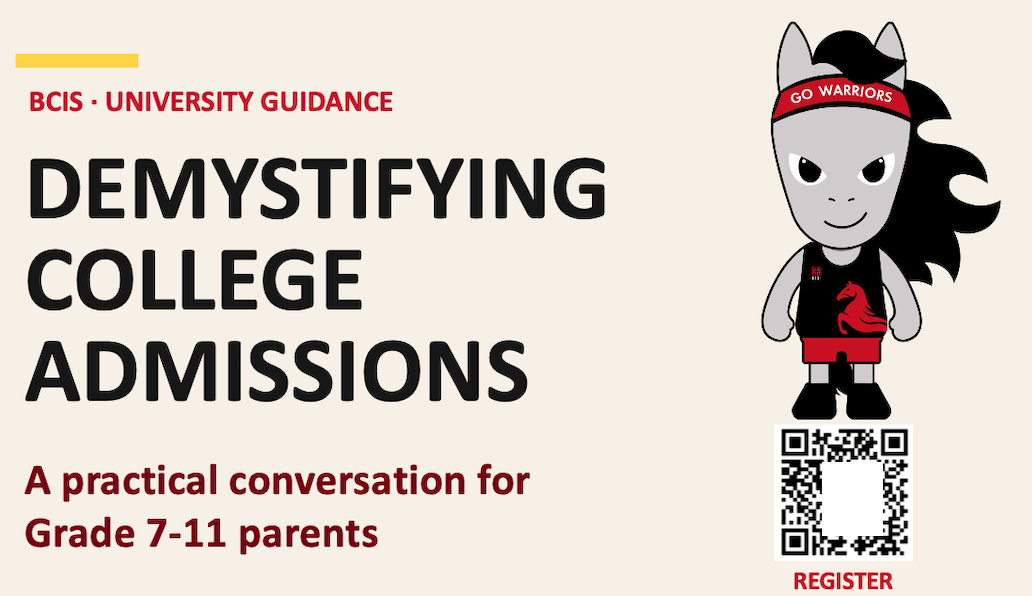
Last week, we hosted two College Counseling Town Halls for parents at BCIS. One was specifically for our Grade 12 families, who are very much in the middle of the university application process right now, and the other was for families in Grades 7 through 11, some of whom have children for whom university probably still feels a very long way away. I had the opportunity to open both sessions, and although the conversations that followed were quite different, I started both in the same place: goals.
I have written before about my belief in trying to live a purpose-driven life. Most mornings, I take a few minutes to set an intention for the day because I find that having something I am working toward gives me direction and helps me make better decisions about where I invest my time and energy. Goals work in much the same way. If we know where we are trying to go, we can begin making intentional choices that move us in that direction, and we can more easily recognize the things that might distract us or pull us off course.
We have seven goals for the High School at BCIS this year, and Goal 4 is focused on high academic outcomes and top-tier university admissions. It is an ambitious goal, and I am comfortable with that. I think schools should be ambitious for their students. We should believe they are capable of extraordinary things and create the opportunities, support, and challenge necessary to help them get there. But I also think there is a danger in becoming so focused on a destination that we begin treating everything that happens along the way as simply preparation for arriving there.
That was one of the things I appreciated most about listening to our University Guidance Counselors, Burcin Arslan and Danielle Li, talk with parents. For our Grade 12 families, the conversation was understandably quite practical. Students are writing essays, managing deadlines, requesting recommendations, preparing for interviews, and navigating application systems around the world. Burcin and Danielle talked about the individualized support they provide throughout that process, but they also described Grade 12 as both a critical and vulnerable year. The work isn’t simply about producing strong applications. It is about supporting young people through a pretty significant moment in their lives.
The conversation with our Grades 7-11 families was different, and one line from that presentation has stayed with me: “Don’t build the application. Build the person.” For our youngest students, the message was almost reassuringly simple. They don’t need a university list yet. They don’t need to prepare for the SAT, choose a major, build a résumé, publish research, or start a nonprofit because they think it will someday look good on an application. They need to read. They need to try things. They need to join groups, learn to communicate, develop good habits, take some risks, and occasionally discover that something they thought they would love isn’t actually for them. That’s okay. At that age, trying is part of the point.
As students get older, that exploration gradually becomes more intentional. In Grade 9, we want students noticing the subjects and activities that genuinely interest them while developing the organization, independence, and time-management skills they will need later. In Grade 10, they begin making more purposeful decisions about academic pathways based on their strengths, interests, and future goals. By Grade 11, university research and application preparation become much more structured. There is a time for each of these things, and trying to rush the process doesn’t necessarily give students an advantage. Sometimes it just means asking a fourteen-year-old to make decisions before they have had enough experiences to know who they are.
I particularly like the way our counselors framed the choice between IBDP and IDEATE. The question isn’t, “Which program is better?” It is, “Which program allows this student to demonstrate their best?” That is an important distinction. Different students have different strengths, interests, learning preferences, and goals. The purpose of having different pathways isn’t to create a hierarchy between them. It is to help students make intentional choices about the pathway that will allow them to thrive.
The same philosophy showed up when Burcin and Danielle talked about extracurricular activities and summer experiences. An expensive program with the name of a famous university attached to it isn’t automatically more meaningful than a summer spent working, volunteering, reading, building something, or pursuing an independent project. Their advice to families was essentially to choose purpose over prestige. What matters is whether the experience is genuine, connected to the student’s interests, and contributes to their growth.
All of this made me think deeply about our High School goal. Yes, I want our students to achieve exceptional academic outcomes. I want them to have access to outstanding universities around the world, including highly selective institutions when those universities are the right match for their aspirations. But I don’t want students to spend their High School years constructing an application. I want them to spend those years constructing a life.
I want them to discover subjects that fascinate them and questions they can’t stop thinking about. I want them to try activities simply because they sound interesting, without worrying about whether they will eventually deserve a line on a résumé. I want them to develop friendships, learn how to organize their time, take some risks, fail occasionally, change their minds, and gradually develop a better understanding of who they are and what they care about. Then, when Grade 12 arrives and someone asks them to write an essay explaining who they are, hopefully they don’t have to manufacture an answer. They have spent the previous several years becoming that person.
There was one other part of the presentation that I thought was especially important. Burcin and Danielle talked about how the role of parents changes as students move through this journey. In Grades 7 and 8, parents can expose children to opportunities, encourage them to be brave, and notice what lights them up. As students get older, the role gradually shifts toward asking questions, listening, supporting decisions, and eventually trusting them to lead their own process. I think that progression is probably harder than it sounds. As parents, our instinct is often to help, and sometimes helping means stepping in. But sometimes helping also means creating enough space for our children to figure something out for themselves.
Maybe that is what I took away most from both evenings. Goal 4 gives us a destination, and destinations matter. They help us set priorities, measure progress, and hold ourselves accountable for providing students with the opportunities they deserve. But our students are not outcomes, and their lives are not applications.
If we do this well, our graduates will leave BCIS with strong academic results and exciting opportunities ahead of them. Hopefully, many will find themselves studying at some of the world’s outstanding universities. But they should also leave knowing more about what interests them, what they are capable of, what they value, and who they want to become.
The university acceptance is worth celebrating. The person receiving it desrves celebrating even more.
 Garrenteed Learning