
Walk into many classrooms and you will see some version of “I do, we do, you do.” The teacher models the skill, the class practices it together, and then students try it on their own. It is so common that most of us absorbed it long before anyone gave it a name, and for good reason. Gradual release gives students a clear picture of what success looks like, it lowers the anxiety of starting cold, and when the goal is a precise procedure, such as balancing a chemical equation or citing a source correctly, it is both efficient and kind. I have used it, I have coached teachers to use it well, and I will keep recommending it. My concern is not that it is wrong, but that it has quietly become the default, and defaults have a way of shaping far more than we intend.
When the teacher goes first, the teacher’s thinking becomes the frame through which every student sees the problem. That frame is helpful, but it is also a restraint. Once students have watched an expert solve something one way, the most natural move is to copy the shape of that solution, and the range of possible approaches narrows before a single student has had the chance to wonder. What looks like independent practice in the “you do” stage is often much closer to imitation. Students are iterating, but they are iterating inside someone else’s thinking.
I think about the student who, left alone with a problem, might have tried something unusual, made a bit of a mess, and in the process discovered something real about how the idea works. In a strict I do, we do, you do sequence, that student rarely gets the chance. The productive struggle that builds understanding has been smoothed away by the model, and some of the ownership goes with it. Over time, students learn that the answer lives with the teacher and that their job is to retrieve it, which is the opposite of what we hope learners will come to believe about themselves.
So, I want to make a case for sometimes turning the sequence around. In a “you do, we do” approach, students begin with the problem on their own, generating ideas before they have seen anyone else’s. They then partner or work in small groups to compare, defend, and refine what they came up with. Only after that does the teacher step in to guide, connect, and clarify, often by building on the very approaches students have just produced.
The difference in the room is noticeable. When students think first, they arrive at the partner conversation with something to say, and the discussion becomes a genuine exchange of ideas rather than a quiet check for the right answer. Original thinking has room to surface because nothing has yet told students what the solution is supposed to look like. When the teacher finally offers guidance, it lands differently, because students have already grappled with the question and the explanation now answers something they actually care about. The teacher can also point to a student’s approach and say, “Look at what this group tried,” which tells every learner in the room that their thinking is worth something.
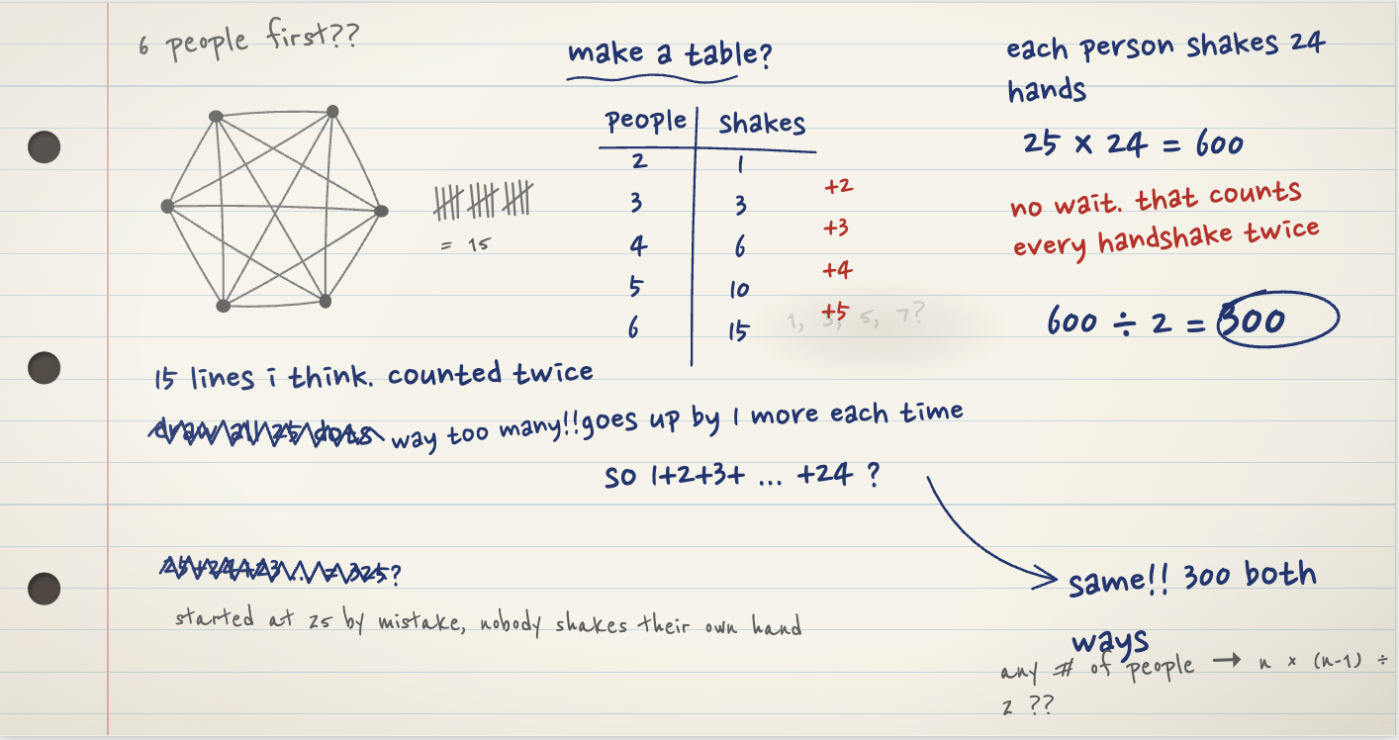
Picture a Grade 9 math class given a simple question: if everyone in a room of 25 people shakes hands with everyone else exactly once, how many handshakes happen? In an I do, we do, you do lesson, the teacher would likely show the formula, work through an example together, and then hand out a set of similar problems. In a you do, we do lesson, students spend the first ten minutes on their own. One draws a web of dots and lines and starts counting, another makes a table beginning with two people and looks for a pattern, and a third reasons that each person shakes 24 hands and then realizes every handshake has been counted twice. When partners compare, they discover that different paths led to the same answer, and they start asking why. By the time the teacher brings the class together, the formula is no longer something handed down from the front of the room. It becomes the elegant summary of thinking the students have already done, and the student who drew the web can see exactly how her messy diagram connects to it.
The same shift works just as well in the humanities. Imagine a Grade 10 history class handed a wartime recruitment poster with no caption and no context. Rather than opening with a lecture on propaganda techniques, the teacher asks students to spend a few minutes alone writing down who they think made the poster, who it was meant for, and what it wanted people to feel. One student focuses on the colors and the heroic figure at the center, another notices who is missing from the image, and a third wonders whether it would have worked on her own grandparents. When partners share, their readings collide and sharpen each other. By the time the teacher introduces the historical context and the language of persuasion, students are not memorizing a list of techniques. They are recognizing names for things they have already noticed, and they are far more likely to spot those same moves in the media they scroll past every day.
This approach carries its own risks, and I would be doing teachers a disservice if I pretended otherwise. When students work without a model, some will build their ideas on misconceptions, and those misconceptions can harden during partner work if both students share the same misunderstanding. Undoing a confident wrong idea takes more time than preventing it, so the teacher needs to listen closely during the first two stages to know what will need untangling later. Some students also find a blank start genuinely stressful, particularly those who are still building language or confidence, which means the opening task has to be accessible enough that everyone can begin somewhere.
Neither sequence is right in every case. When the learning is a precise skill where an early mistake could become a lasting habit, or where safety matters, modeling first makes good sense. When the learning invites interpretation, problem solving, design, or multiple valid paths, letting students think first opens doors that a model would close. The real skill for teachers is not choosing a side, but recognizing which kind of learning is in front of them on a given day and being willing to change the order on purpose.
I often come back to a simple question when I visit classrooms: who did the thinking first? It is not meant to catch anyone out, but it reveals a great deal about what students are learning beyond the content itself. If the answer is always the teacher, students may become very good at following, which is useful but not enough. If students sometimes get to go first, to try, stumble, compare, and then refine their ideas with expert guidance, they learn that their own thinking is worth starting with. That belief, more than any single lesson structure, is what I hope our students carry with them long after they leave our classrooms.

